Your Steam CTR number is lying to you. Pick your capsule with paid ads instead.
The short version of a much longer write-up on what ~$5,100 of wishlist ads taught me. This one has the advice list and the single most useful trick. The long one has the data, the math, and all my mistakes, priced out: lonepiggy.com/paidAds
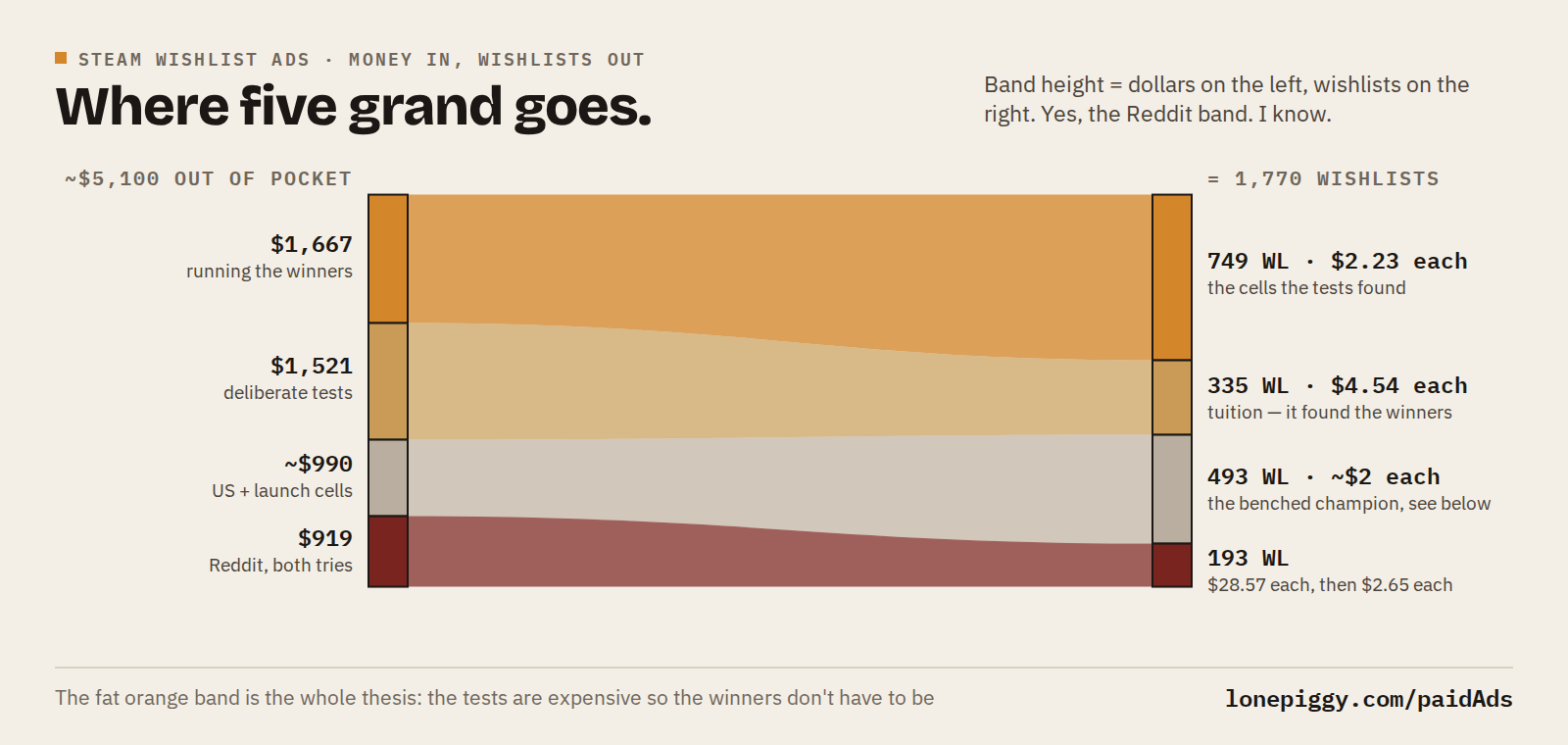
I make games alone. Right now that means Kegs of Eternity, a roguelite deckbuilder about seven dwarf brothers rebuilding a settlement, with cards, steel and an irresponsible amount of beer. Between late April and the end of August 2026 I ran UTM-tagged paid ads on X and Reddit pointed at my Steam page, so Steam could tell me exactly which clicks turned into wishlists: ~$5,100 of my own money, ~1,770 wishlists, roughly $2.88 each, including everything I spent on tests that existed only to teach me something.
Disclosures, short form: I'm not a data scientist or a marketing guy, just a dev measuring things - the long article has the full calibration. I used Claude to help me parse a shitload of ads data and to write or edit parts of both articles, tho the data and the article are mine. All numbers in USD (X billed me in euros, converted at €1 = $1.16; Reddit billed dollars).
Shorthands, because I'm lazy: CPWL = cost per wishlist. pSI = share of your visitors signed into Steam when they landed (if they aren't, they can't wishlist). V2WR = visits-to-wishlists rate - wishlists per signed-in visit. WLTR = wishlist-through-rate - wishlists per Steamland impression. Steamland = everything inside Steam's own store: discovery queue, tags, more-like-this, search, the front page.
The advice list
Confidence level in brackets. The reasoning and data behind every one of these is in the long article.
- Use paid ads to pick your Steam capsule, and stop staring at Steam's CTR number. [high] Full method below - it's why this post exists.
- Turn web/desktop off. [high] Sounds insane for a Steam game. It isn't. A desktop click opens the Steam page in a browser where the person isn't logged in, so they can't wishlist without a 2FA dance most of them skip. A phone click opens the Steam app, where they're already logged in, and wishlisting is one tap. My desktop clicks converted at 0.8%; Android clicks from the same ad at 11.5%.
- Split Android and iOS into separate ad groups and bid them separately. [high] Android clicks wishlist at 1.2-3.8x the rate of iOS clicks, typically 2-3x, in every country with enough data to say. Bid to equalize CPWL between them.
- Judge everything on CPWL from Steam's UTM dashboard, never on CPC from the ad dashboard. [high] I killed my second-best country because its CPC looked expensive. Wait for the wishlists.
- The first 48 hours of any new ad cell are a lie. [high] My four best cells did $0.64-0.80 CPWL in their first two days and $1.44-4.01 after that. Same ad, same targeting, same bid. Don't scale a number you got on day one, and treat anyone quoting 50 cents per wishlist as quoting their day one.
- Sustained spend in one cell decays. [medium] France/Android went from $1.65 CPWL in its first week to $5.02 across July-August. Pausing five weeks and restarting bought back two cheap days, then decay resumed.
- Localized ads in non-English markets were cheaper per wishlist than English ads in non-US English-speaking countries. [high on direction, medium on ranking] Japan was my best market at $1.22 CPWL, matching the US. Germany, Spain and France beat the UK, Canada and Australia. Korea didn't work. "The US and the Anglosphere are the same market" is wrong.
- Use max-CPC bidding. Start around $0.07-0.12 and treat the max bid as a delivery throttle, not just a price cap. [high on the mechanic] A 20% lower max bid got me 20x fewer impressions overnight - the bid decides whether you enter auctions at all.
- Reddit Ads isn't 20x worse than X. I was wrong about that. [medium] Recommended settings burned $1,000 in a day at $28.57 CPWL; manual bids and actual attention got $2.65, same ballpark as X. Reddit clicks cost 7-11x more but wishlist at 7x the rate. I still prefer X, for speed and volume.
- A JPEG beats a trailer for paid ads. [high] The trailer converted visitors at less than half the rate of a boring static image with a one-line pitch. Clicks are free on Steam and expensive on X; design the ad creative for the second thing.
- Budget exploration separately from exploitation. Of the $3,188 I have full data for, $1,521 was deliberate tests at $4.54 CPWL, and $1,667 was running the winners at $2.23 - the best winners closer to $1.20. The tests are what found the winners.
- The dashboard only grades the cells you're running. [learned it writing the long article] In mid-May I benched my best market - the US, at close to my best CPWL - to fund the country tests, and it never got re-entered into the tournament. It still ended up as 37% of all my wishlists, by visitor country, off a two-week window. No dashboard number flags "you stopped funding your champion," so keep a list of what you're NOT running and re-audition it on purpose.
- Export your data BEFORE you delete anything in the ads manager. [learned the expensive way] Deleted ad groups vanish from exports retroactively. Roughly a grand of my launch-phase spend now exists only as reconstructed estimates with tildes in front.
These are for wishlist-conversion campaigns specifically, current as of mid-2026, and my percentages are calibration data for my game, not laws of physics. The mechanisms should transfer; the numbers won't.
Use ads to optimize your capsule and Steamland clicks
This is the part I'd put on a billboard if billboards took UTM tags.
The job of your capsule in Steamland is to win the competition for eyeballs while sitting next to a bunch of other capsules. But the thing that makes Steamland completely different from paid ads is that Steam capsule impressions are free - and so are the clicks! Nobody's billing you per click, so your incentive is to push CTR as high as it'll go.*
Except optimizing CTR on Steam is nigh impossible, because Steam's CTR metric sucks. Devs love to obsess over that number; the problem is that it doesn't track true CTR. Bring in any external traffic - doesn't matter if it's thru ads, tweets, videos, news articles, whatever - and every one of those visits counts toward that CTR without a matching Steam impression, so it goes up. And if your game starts selling well, Steam starts showing it everywhere to everyone, so it goes down. Highly successful games will actually have a LOWER number. A metric that goes up when you tweet and down when you succeed is too contaminated to tell you anything - total no bueno. Stop obsessing over it, and stop using it to judge your capsule.
*The REAL metric you want to optimize for is wishlist-through-rate: how many wishlists you get per impression.
WLTR = CTR × V2WR
If I put some nice boobs in my capsule, my capsule's CTR (the actual one, not the one Steam shows) might go up. Maybe by a lot. But those visitors are looking for games they can play with only one hand. Erm, yeah sure, you can actually play my game with one hand... but there will be nothing for them to do with the other hand, so my V2WR craters, because I'm attracting the wrong visitors. Free clicks from the wrong people are still worth zero.
So the capsule's job in Steamland is to win the competition for eyeballs - in a world where clicks are free, which is a very different world than ads - AND to bring in the right kind of eyeballs. How do you optimize for both? Most indie devs I see change or upgrade their capsule, then watch their Steam wishlist numbers and that CTR metric to see if things improved. As I said before, I'm not a data scientist, but holy crap, is that method irredeemably flawed. Your wishlist count moves with festivals, with your tweets, with what Steam decided to feature that week, with the weather; the CTR moves for the reasons above. You're reading tea leaves in a wind tunnel.
We can use paid ads and UTM tags to filter out most of that noise:
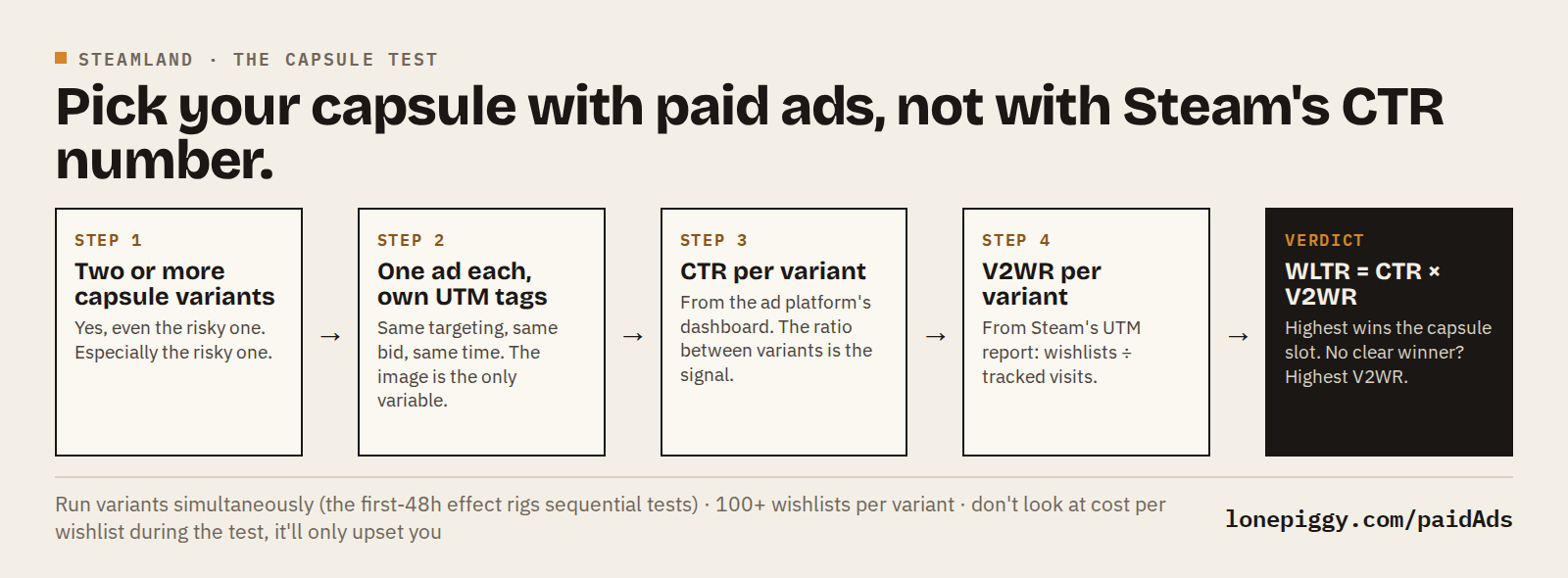
- Make two or more capsule variants.
- Make a separate ad for each one, each with its own UTM tags. Same targeting, same bid, same countries, same everything except the image.
- Run them at the same time. Not one this week and one next week, or the first one wins because of the first-48-hours thing (see item 5 above), not because it's better.
- Set your bids slightly higher than you normally would, so you're not starved for volume (a lower cap doesn't just lower your price, it takes you out of auctions - see item 8).
- Get each variant's CTR from your ad platform's dashboard. Your capsule's real CTR on Steam will NOT be the same as on a social feed, but the ratio is a decent enough proxy: if the boobs capsule gets twice as many clicks on X as the non-boobs one, that ratio is probably gonna hold on Steam.
- Get each variant's V2WR from Steam's UTM page: wishlists divided by tracked visits. Tracked visits, not visits, so you're measuring your capsule and not the platform's sign-in problem.
- WLTR = CTR × V2WR. Pick the capsule with the highest WLTR.
- If there's no clear winner (a gap of at least ~10%), pick the one with the highest V2WR (specially if there's a clear winner there). That's the more "honest" capsule, and it'll serve you best everywhere the game gets shown outside Steam.
Note: the winner here is probably NOT the best creative for your actual paid ads, and it can have a SIGNIFICANTLY higher CPWL than a good screenshot of your game (my capsule pulled a 3.2% sign-in rate as an ad). You're paying for information - do not look at CPWL while running this test, it'll only upset you. And you want at least a hundred wishlists per capsule you're testing to get a decent sample (more is better), so the information cost is non-trivial: at my numbers, call it a few hundred bucks per variant on mobile targeting, and a lot more if you make the mistake of running it on desktop. It's the only controlled capsule test I know of that produces reliable numbers.
Want the rest?
The long write-up has the data behind all of it: the deep-link quirk that makes a phone click worth 5-14 desktop clicks, the first-48-hours effect and the decay curves, the country-by-country numbers and the language-moat finding, the Reddit story, the part where I discover mid-article that I benched my best market in May, the break-even math with regional pricing, and every prediction of mine the data ran over with a truck. lonepiggy.com/paidAds
Who I am: making games since 2001 - Iron Man VR and Batman: Arkham Shadow are the ones you might know. These days I'm solo-developing Kegs of Eternity, the roguelite deckbuilder all these wishlists were for. Part 2 lands first on @LonePiggyGames.